Personalized cast dumbbells · first offering
A weight with their name cast into it.
You order online: pick a weight and a name (or a date, or a few words). I 3D-print a thin shell, cast it solid in a stone mix around a rod core, and ship one engraved weight, made for one person. A gift and a trophy piece, not gym equipment.
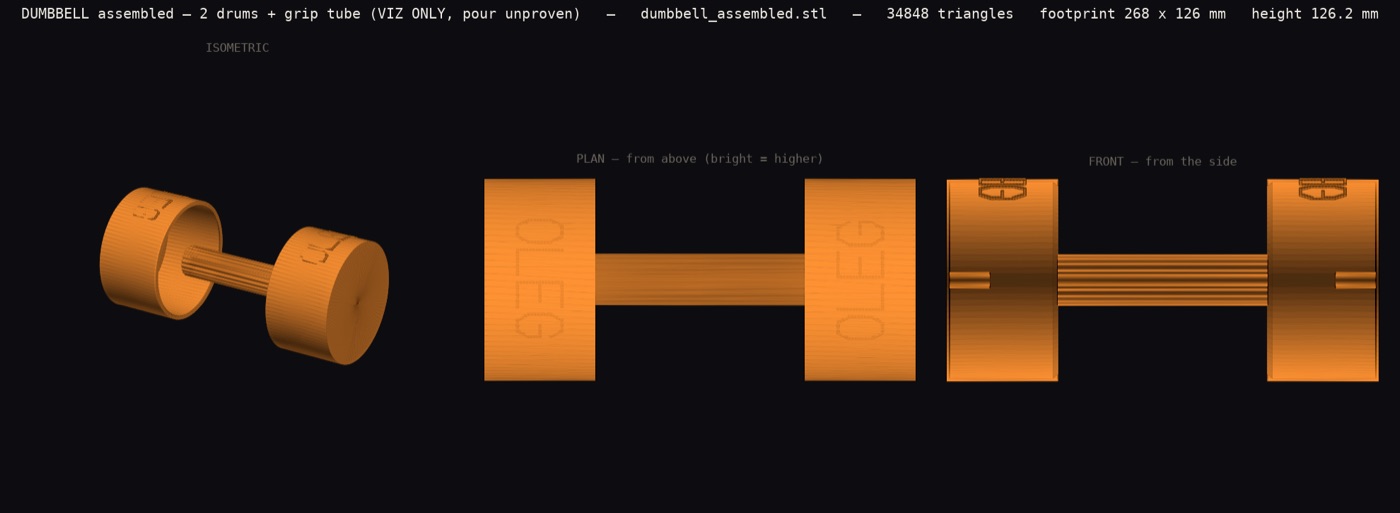
Provenance: verified 2026-08-04. The image names its own source across the top: dumbbell_assembled.stl at 34,848 triangles, 268 x 126 x 126 mm. It was drawn by tools/render_stand_stl.py in the public crackle repository, and re-running that script against the current build file reproduces this image, checked pixel against pixel on 2026-08-04. Extracted from the page into a file on 2026-08-04.
This is a brand-new offering. One person makes these. Nothing has been cast or shipped yet. If you order, you are the first. There is no shop behind this, no queue, no reviews to read.
The 3D-printing engine underneath is real and already running on other objects (proof linked below). The cast-dumbbell product is a beginning, not a business. One step is still ahead of me: the pour itself, filling a shell with the stone mix, has not been physically proven yet. You should know that before you write, not after.
A trophy that actually weighs something
Most trophies are hollow. This one is not. It is a real weight with a real name cast into it: a first 5k, a coach's last season, a wedding date, ten years of showing up at 6am. The lettering is raised out of the cast end cap, part of the object from the moment it sets. Not a plaque, not a sticker, not an engraving added after.
It is meant to be held in two hands, put on a desk, handed over at a finish line. It will happily get curled between meetings, but nobody buys it to replace a dumbbell rack.
Made for:
How an order works
Render-first, always. Nothing gets made until you have seen a render of your piece and said yes. No money changes hands before that.
- 01Tell me the weight, the name or message, and the occasion.A first race, a coach, an anniversary, a joke that stuck. The occasion shapes the piece.
- 02I design it and show you a render and a price.The render is generated from the actual build file, so what you see is what would print.
- 03You approve before anything is made.You owe nothing at this point. If the words sit wrong or the size surprises you, we change it or drop it.
- 04I print and cast it.Thin printed shell, stone mix poured around the rod core, left to set solid.
- 05It ships.One engraved weight, made once, for one person.
How it's actually made
The dumbbell starts as a thin 3D-printed shell, a formwork in the casting sense. The print supplies the shape and the lettering. It is the skin of the piece, not the mass.
The shell is filled with a gypsum-and-sand mix that sets solid around a bamboo or steel rod running the full length of the handle. The rod is load-bearing, and that is a rule, not a preference: a solid cast handle would snap. The stone gives the weight, the rod gives the strength.
The raised lettering on the printed end cap becomes part of the cast surface. The name is in the object, not on it. No sticker, no plate, no engraving after the fact.
The piece is drawn as code, name and all, so the render you approve is generated from the actual build file, not a marketing mockup. What you approve is what prints. It is the same engine behind alien.tech.senku.im.
Bulky by design
Cast stone runs about 1.9 grams per cubic centimetre. Gym iron runs 7.8. So at the same weight, a cast piece is roughly four times the volume of the dumbbell you know from the rack. That is not a flaw to apologise for. It is the look: generous, rounded masses that fill two hands. The sweet spot is 1 to 6 kg. These are meaningful, engraved, hold-in-two-hands gifts, not competition plates.
| Total weight | Each end, about | In the hand |
|---|---|---|
| 1 kg | 80 mm ball | an orange |
| 2 kg | 100 mm ball | a grapefruit |
| 5 kg | 136 mm ball | a cantaloupe |
| 10 kg | 171 mm ball | getting large. Ask first. |
What's proven, and what isn't
The rule on everything I publish: you should know the real stage at a glance, not after you have committed. So here it is, split honestly.
✓ Proven, and in use today
- The continuous-line printing engine, measured on real printers and running on other objects now at alien.tech.senku.im.
- Parametric name-embossing: the name is drawn into the build file, so the render you approve is the file.
- Bamboo-and-printed-rod joinery, used on parts already built.
- The engine and its measurements are public and free to copy at take.senku.im.
○ Not proven yet, first orders will teach it
- No dumbbell has been cast or shipped. No customer has received one.
- The pour itself is untested. Shells and lettering print today; filling one with the stone mix is the step the first piece proves.
- Balance and surface finish will be learned on the first pieces.
- There is no price list, because there is no track record to base one on. Every quote is per piece.
- Lead time is a genuine estimate, not a history.
Be the first order
There is no cart and no checkout. On purpose. Tell me the weight, the words, and the occasion, and I will come back with a render and a price before you owe anything.
You would be the first. If the weight or the words are outside what I can do well yet, I will say so plainly rather than take the order.
Goes to Oleg directly. No list, no auto-reply, no obligation.